Data Center Construction and Schedule Coordination
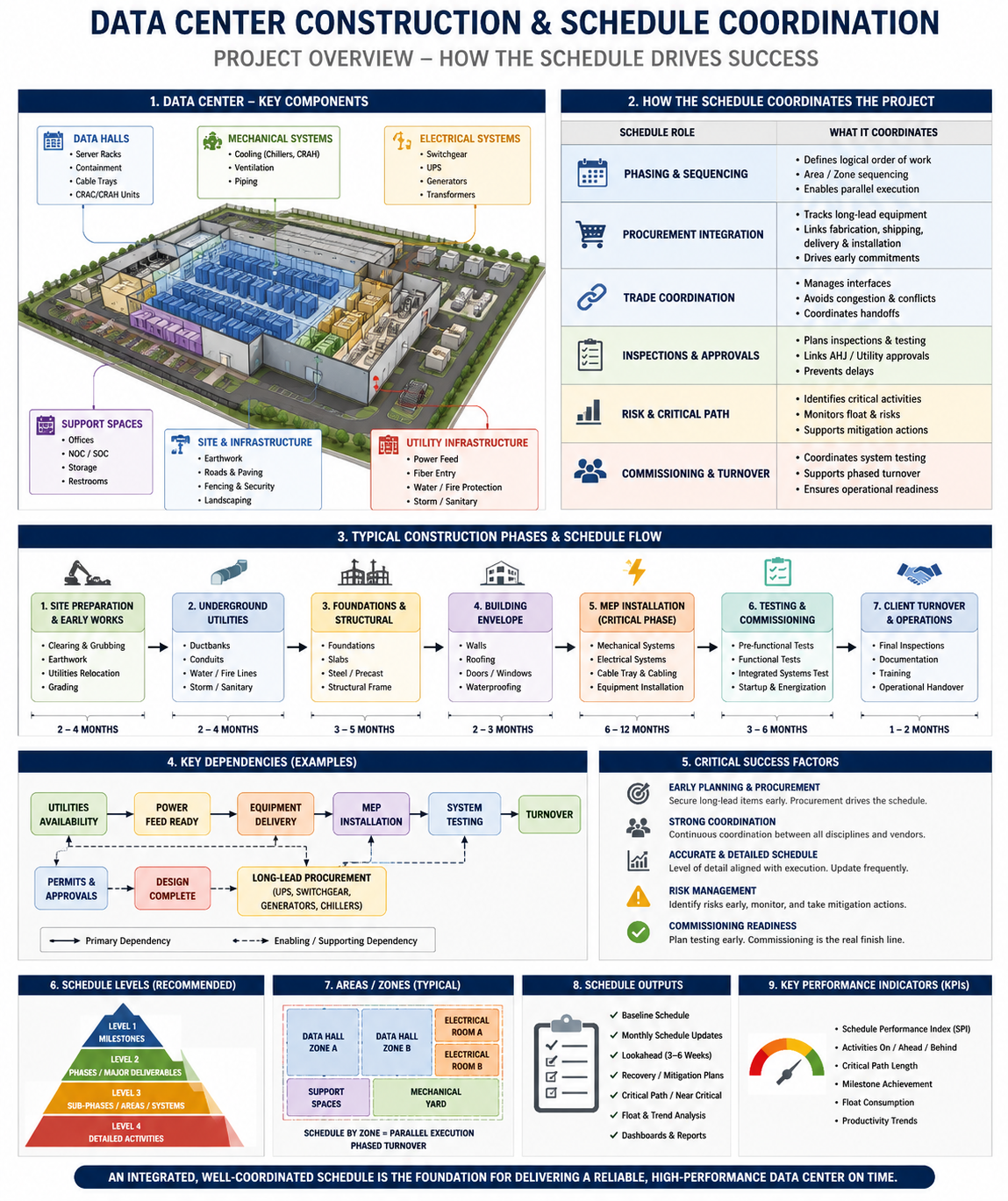
The construction of modern data centers has become one of the most complex and schedule-sensitive sectors within the construction industry.
Source: VORTEX
The construction of modern data centers has become one of the most complex and schedule-sensitive sectors within the construction industry. Unlike conventional commercial buildings, data centers combine heavy civil works, industrial-scale MEP systems, mission-critical infrastructure, utility coordination, high-density technology integration, and extremely demanding commissioning requirements — all under aggressive delivery timelines driven by owners, hyperscalers, and cloud providers.
In this environment, the construction schedule is no longer just a reporting tool.
The schedule becomes:
- the operational roadmap,
- the coordination platform,
- the procurement control system,
- the commissioning strategy,
- and ultimately the central management system of the entire project.
A poorly coordinated schedule in a data center project can rapidly create cascading impacts across procurement, utilities, energization, testing, and turnover activities. Conversely, a properly developed and actively managed CPM schedule can significantly improve productivity, reduce interface conflicts, support phased turnover, and protect critical milestones.
𝐔𝐧𝐝𝐞𝐫𝐬𝐭𝐚𝐧𝐝𝐢𝐧𝐠 𝐭𝐡𝐞 𝐂𝐨𝐦𝐩𝐥𝐞𝐱𝐢𝐭𝐲 𝐨𝐟 𝐃𝐚𝐭𝐚 𝐂𝐞𝐧𝐭𝐞𝐫𝐬
Data centers differ from traditional buildings because their primary objective is not architectural completion — it is operational readiness.
A conventional office building may be considered substantially complete once finishes, systems, and occupancy requirements are finalized. A data center, however, is only truly complete when:
- systems are energized,
- cooling is operational,
- redundancy is verified,
- integrated systems testing is complete,
- commissioning is accepted,
- and the owner can safely deploy live IT operations.
This changes the entire scheduling philosophy.
Construction activities alone do not drive the project.
The real drivers are:
- procurement,
- utility readiness,
- commissioning sequencing,
- testing dependencies,
- and owner turnover requirements.
𝐌𝐚𝐢𝐧 𝐂𝐨𝐦𝐩𝐨𝐧𝐞𝐧𝐭𝐬 𝐨𝐟 𝐚 𝐃𝐚𝐭𝐚 𝐂𝐞𝐧𝐭𝐞𝐫 𝐏𝐫𝐨𝐣𝐞𝐜𝐭
Most data center projects can be divided into several major construction and operational systems:
𝟏. 𝐒𝐢𝐭𝐞 & 𝐂𝐢𝐯𝐢𝐥 𝐈𝐧𝐟𝐫𝐚𝐬𝐭𝐫𝐮𝐜𝐭𝐮𝐫𝐞
This includes:
- clearing and grubbing,
- grading,
- storm drainage,
- roads and paving,
- underground utilities,
- site security,
- and utility corridors.
These activities usually begin before vertical construction and often establish the first critical path of the project.
One of the largest scheduling risks during this phase is underground utility coordination. Electrical ductbanks, fiber pathways, storm systems, sanitary lines, and grounding systems frequently compete for limited corridor space. Poor sequencing in underground works often creates rework, congestion, or inspection delays later in the project.
The schedule must therefore:
- coordinate utility installation by area,
- manage inspection sequences,
- integrate utility company requirements,
- and ensure underground completion before foundations begin.
𝟐. 𝐒𝐭𝐫𝐮𝐜𝐭𝐮𝐫𝐚𝐥 𝐂𝐨𝐧𝐬𝐭𝐫𝐮𝐜𝐭𝐢𝐨𝐧
The structural phase includes:
- foundations,
- slabs,
- steel erection,
- precast installation,
- and building framing.
In many large hyperscale facilities, structural sequencing is heavily driven by procurement and crane logistics rather than labor productivity alone.
The schedule must coordinate:
- steel fabrication,
- delivery dates,
- erection sequencing,
- concrete curing durations,
- and handoff between structural zones.
Many projects now use area-based scheduling approaches, where the facility is divided into:
- data halls,
- electrical rooms,
- support spaces,
- and commissioning zones.
This allows phased turnover and parallel execution.
Without area-based scheduling, data center projects frequently lose visibility into turnover readiness.
𝟑. 𝐁𝐮𝐢𝐥𝐝𝐢𝐧𝐠 𝐄𝐧𝐯𝐞𝐥𝐨𝐩𝐞
Dry-in milestones are extremely important in data center projects.
The envelope phase includes:
- roofing,
- waterproofing,
- walls,
- doors,
- exterior systems,
- and weather protection.
The schedule must prioritize enclosure completion because interior MEP activities cannot progress efficiently without environmental protection.
This phase often becomes a hidden critical path driver.
Even if structural works remain ahead of schedule, delays in dry-in activities can prevent:
- electrical rough-in,
- cable installation,
- equipment startup,
- and commissioning preparation.
The schedule should therefore track:
- partial dry-in dates,
- weather-sensitive activities,
- and phased enclosure turnover.
𝟒. 𝐌𝐄𝐏 𝐒𝐲𝐬𝐭𝐞𝐦𝐬 – 𝐓𝐡𝐞 𝐑𝐞𝐚𝐥 𝐂𝐨𝐫𝐞 𝐨𝐟 𝐭𝐡𝐞 𝐏𝐫𝐨𝐣𝐞𝐜𝐭
The MEP phase is where data center scheduling becomes truly complex.
This includes:
- switchgear,
- UPS systems,
- generators,
- transformers,
- cooling systems,
- CRAH/CRAC units,
- piping,
- cable tray,
- controls,
- fire protection,
- and low-voltage systems.
This phase usually drives the longest and most sensitive critical path of the project.
A major challenge is that multiple trades operate simultaneously within highly congested areas. Electrical, mechanical, controls, fire protection, and commissioning teams often work concurrently in the same spaces.
Without detailed schedule coordination:
- work stacking occurs,
- productivity drops,
- access conflicts increase,
- inspections become delayed,
- and turnover dates slip rapidly.
The schedule must therefore:
- sequence work by area,
- coordinate trade access,
- manage vendor interfaces,
- integrate procurement milestones,
- and track installation readiness at a detailed level.
𝐏𝐫𝐨𝐜𝐮𝐫𝐞𝐦𝐞𝐧𝐭 𝐃𝐫𝐢𝐯𝐞𝐬 𝐭𝐡𝐞 𝐒𝐜𝐡𝐞𝐝𝐮𝐥𝐞
One of the defining characteristics of data center construction is the influence of long-lead procurement.
Major equipment can require:
- 40 to 80 weeks fabrication,
- factory acceptance testing,
- international shipping,
- customs clearance,
- specialized transportation,
- and startup support.
Typical long-lead items include:
- switchgear,
- generators,
- transformers,
- UPS systems,
- chillers,
- cooling equipment,
- and electrical controls.
In many projects, procurement becomes the actual critical path.
For this reason, the CPM schedule must fully integrate:
- submittals,
- approvals,
- fabrication,
- FAT,
- shipping,
- delivery,
- installation,
- and startup activities.
Projects that only track field construction without procurement integration usually lose visibility into major future risks.
𝐂𝐨𝐦𝐦𝐢𝐬𝐬𝐢𝐨𝐧𝐢𝐧𝐠 𝐂𝐡𝐚𝐧𝐠𝐞𝐬 𝐄𝐯𝐞𝐫𝐲𝐭𝐡𝐢𝐧𝐠
Commissioning is the most schedule-sensitive phase of any data center project.
Unlike conventional construction, data centers require:
- pre-functional testing,
- functional testing,
- integrated systems testing (IST),
- redundancy validation,
- startup sequencing,
- and owner witness testing.
Commissioning dependencies are extremely interconnected.
For example:
- generators cannot be tested without fuel systems,
- switchgear cannot be energized without inspections,
- cooling systems cannot operate without controls,
- integrated testing cannot proceed without all supporting systems ready.
A single missing component can stop dozens of downstream activities.
Therefore, commissioning logic must be developed with the same level of detail as construction logic.
The schedule should include:
- system-by-system turnover,
- testing sequences,
- commissioning milestones,
- owner witness dates,
- and readiness reviews.
This is where many schedules fail.
Projects often maintain detailed construction logic but insufficient commissioning logic. As a result, the project appears ahead during construction but collapses during startup and testing.
𝐓𝐡𝐞 𝐈𝐦𝐩𝐨𝐫𝐭𝐚𝐧𝐜𝐞 𝐨𝐟 𝐙𝐨𝐧𝐞-𝐁𝐚𝐬𝐞𝐝 𝐒𝐜𝐡𝐞𝐝𝐮𝐥𝐢𝐧𝐠
Modern data centers are rarely delivered as one single turnover.
Most hyperscale projects use:
- phased energization,
- phased turnover,
- phased commissioning,
- and phased occupancy.
The facility is typically divided into:
- data halls,
- electrical zones,
- mechanical yards,
- support buildings,
- and commissioning blocks.
The schedule must reflect this operational strategy.
Zone-based scheduling allows:
- parallel execution,
- earlier commissioning,
- improved turnover planning,
- and reduced project congestion.
It also provides management teams with clearer visibility into:
- readiness,
- float consumption,
- and critical interfaces.
𝐔𝐭𝐢𝐥𝐢𝐭𝐲 𝐂𝐨𝐨𝐫𝐝𝐢𝐧𝐚𝐭𝐢𝐨𝐧 – 𝐎𝐧𝐞 𝐨𝐟 𝐭𝐡𝐞 𝐋𝐚𝐫𝐠𝐞𝐬𝐭 𝐑𝐢𝐬𝐤𝐬
Power availability is one of the biggest schedule risks in data center projects.
Many projects depend on:
- utility substations,
- utility company approvals,
- power feed installations,
- and external energization milestones.
These activities are frequently outside contractor control.
The schedule must therefore:
- integrate utility owner milestones,
- track utility interfaces,
- include contingency planning,
- and monitor external approvals continuously.
A data center may be physically complete yet unable to operate because permanent power is unavailable.
This is why utility coordination must remain highly visible within executive schedule reporting.
𝐂𝐫𝐢𝐭𝐢𝐜𝐚𝐥 𝐏𝐚𝐭𝐡 𝐌𝐚𝐧𝐚𝐠𝐞𝐦𝐞𝐧𝐭 𝐢𝐧 𝐃𝐚𝐭𝐚 𝐂𝐞𝐧𝐭𝐞𝐫𝐬
The critical path in data centers is dynamic.
It frequently shifts between:
- procurement,
- utility readiness,
- structural works,
- MEP installation,
- and commissioning.
Typical critical path sequences may include:
- utility power availability,
- underground ductbanks,
- switchgear procurement,
- building dry-in,
- electrical rough-in,
- energization,
- integrated systems testing,
- owner turnover.
𝐍𝐞𝐚𝐫-𝐜𝐫𝐢𝐭𝐢𝐜𝐚𝐥 𝐩𝐚𝐭𝐡 𝐦𝐨𝐧𝐢𝐭𝐨𝐫𝐢𝐧𝐠 𝐛𝐞𝐜𝐨𝐦𝐞𝐬 𝐞𝐪𝐮𝐚𝐥𝐥𝐲 𝐢𝐦𝐩𝐨𝐫𝐭𝐚𝐧𝐭.
Many projects contain:
- multiple parallel commissioning paths,
- rolling turnovers,
- and concurrent system testing.
The schedule team must therefore continuously monitor:
- float consumption,
- near-critical activities,
- procurement risks,
- and commissioning readiness.
Schedule Reporting Requirements
Effective data center schedule reporting must go far beyond simple Gantt charts.
Executive reporting should include:
- milestone status,
- procurement dashboards,
- commissioning readiness,
- critical path analysis,
- near-critical path analysis,
- float trends,
- recovery actions,
- and risk registers.
𝐋𝐨𝐨𝐤𝐚𝐡𝐞𝐚𝐝 𝐬𝐜𝐡𝐞𝐝𝐮𝐥𝐞𝐬 𝐚𝐫𝐞 𝐩𝐚𝐫𝐭𝐢𝐜𝐮𝐥𝐚𝐫𝐥𝐲 𝐢𝐦𝐩𝐨𝐫𝐭𝐚𝐧𝐭.
Most successful projects maintain:
- 3-week lookaheads,
- 6-week lookaheads,
- commissioning lookaheads,
- and procurement tracking dashboards.
The schedule becomes a real-time operational management tool rather than a monthly reporting exercise.
𝐂𝐨𝐦𝐦𝐨𝐧 𝐒𝐜𝐡𝐞𝐝𝐮𝐥𝐢𝐧𝐠 𝐅𝐚𝐢𝐥𝐮𝐫𝐞𝐬 𝐢𝐧 𝐃𝐚𝐭𝐚 𝐂𝐞𝐧𝐭𝐞𝐫𝐬
The most common schedule management failures include:
- Incomplete Procurement Integration
Projects fail to fully link procurement with field installation.
- Poor Commissioning Logic
Testing activities are added too late or at insufficient detail.
- Trade Congestion
Multiple trades are scheduled simultaneously without realistic workspace coordination.
- Overly Simplified Schedules
Schedules lack sufficient detail to manage real execution.
- Missing Utility Dependencies
External utility risks are underestimated.
- Lack of Area-Based Planning
The schedule does not support phased turnover strategies.
- Insufficient Schedule Maintenance
The schedule becomes disconnected from actual field execution.
- The Role of the Scheduler
In data center construction, the scheduler becomes much more than a planner.
The scheduler acts as:
- coordinator,
- risk analyst,
- procurement integrator,
- commissioning strategist,
- and executive advisor.
The schedule team must continuously coordinate between:
- design,
- procurement,
- construction,
- commissioning,
- utility companies,
- vendors,
- and owner representatives.
This requires:
- strong technical understanding,
- operational awareness,
- and constant communication with field teams.
A scheduler who only updates activities without understanding actual execution will quickly lose control of the project.
𝐅𝐢𝐧𝐚𝐥 𝐓𝐡𝐨𝐮𝐠𝐡𝐭𝐬
Data center construction is one of the most schedule-driven sectors in modern construction.
The complexity of:
- procurement,
- utility coordination,
- MEP integration,
- commissioning,
- and phased turnover
requires a much higher level of schedule development and management than traditional construction projects.
In this environment, the CPM schedule becomes the central coordination platform of the entire project.
A successful data center schedule must:
- integrate procurement,
- support phased execution,
- coordinate trades,
- manage commissioning,
- track utility readiness,
- and continuously monitor risk and critical path evolution.
Ultimately, the quality of the schedule often determines the quality of the project execution itself.
Because in data center construction, the schedule is not just tracking the project.
The schedule is driving the project.