
Where Are Data Centers Really Built?
The surprising connection between population density and America’s digital infrastructure
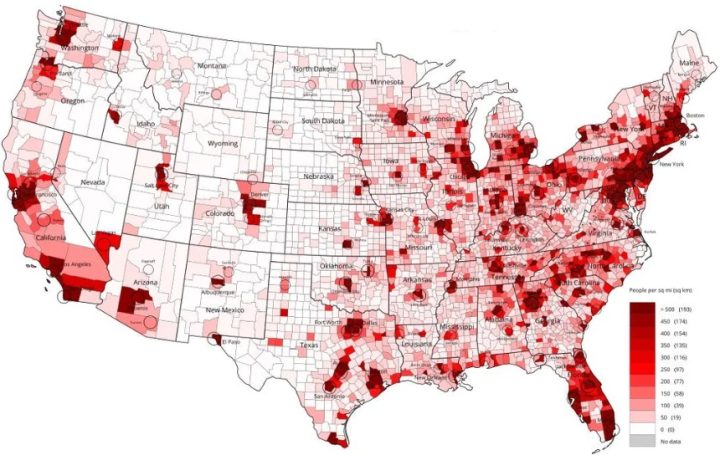
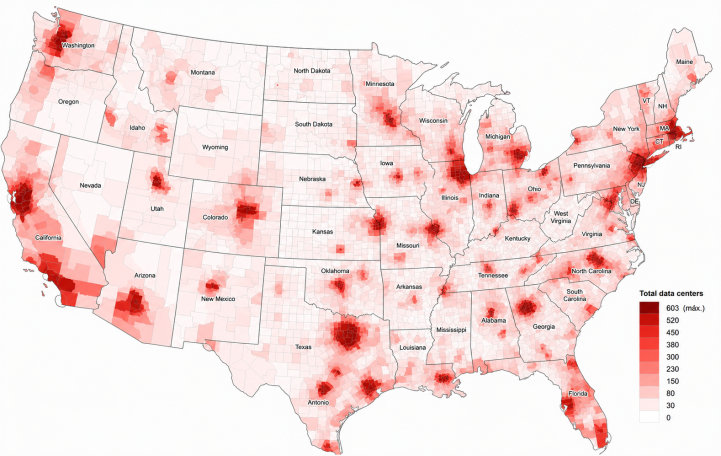
Source: VORTEX and google
Take a look at these two maps. One shows where people live in the United States. The other shows where data centers are concentrated.
At first they seem unrelated. One is population. The other is technology infrastructure. But when you compare it raises an interesting question:
𝐖𝐡𝐲?
If everything today is “in the cloud,” why do data centers still need to be physically close to people?
After all, data travels at almost the speed of light. So theoretically, a server could be anywhere… right? Not exactly.
The reality is that distance still matters — a lot more than most people think. Every time someone opens Netflix, joins a Teams call, uses ChatGPT, uploads a file to the cloud, scrolls Instagram, or plays an online game, information has to travel from the user to a data center and back again. That travel time is called latency.
And while it may only be milliseconds, modern applications are extremely sensitive to delay. A small increase in latency can mean slower AI responses, lag in gaming, buffering in streaming, delays in financial systems, or poor cloud performance for companies.
𝐈𝐧 𝐭𝐡𝐞 𝐝𝐢𝐠𝐢𝐭𝐚𝐥 𝐰𝐨𝐫𝐥𝐝, 𝐦𝐢𝐥𝐥𝐢𝐬𝐞𝐜𝐨𝐧𝐝𝐬 𝐚𝐫𝐞 𝐭𝐡𝐞 𝐧𝐞𝐰 𝐭𝐫𝐚𝐟𝐟𝐢𝐜 𝐣𝐚𝐦𝐬.
That is why data centers tend to be built close to major metropolitan areas. Not because companies simply like big cities, but because the users are there. Where there are more people, there is more streaming, more cloud usage, more mobile devices, more business systems, more AI queries, more everything.
Population density and data consumption are directly connected. But people are only part of the story.
Data centers also follow fiber optic infrastructure. Large cities already have huge communication corridors, internet exchanges, redundant network routes, and telecom infrastructure. Building a hyperscale facility in the middle of nowhere may sound attractive because land is cheaper, but extending fiber, guaranteeing redundancy, and maintaining low latency quickly becomes expensive and inefficient.
And then there is the biggest issue of all: 𝐏𝐨𝐰𝐞𝐫.
Modern data centers consume astonishing amounts of electricity. AI facilities especially are changing the scale completely. Some new campuses require hundreds of megawatts — almost like small cities. That’s why we are now seeing a shift. Historically, data centers followed population first. Now, increasingly, they follow power.
States like Texas, Arizona, Georgia, Ohio, Utah, and Nevada are exploding in data center growth because they offer a powerful combination with available land, lower taxes, strong energy infrastructure, and still enough proximity to major population centers.
The next generation of AI infrastructure may not always be built in the densest cities. Instead, it may be built wherever the grid can support it.
In many ways, these maps tell the story of modern America. A century ago, industries were built around ports, railroads, rivers, and highways. Today, the new industrial revolution is being shaped by fiber optics, electrical capacity, cloud infrastructure, and AI computing power.
Data centers are no longer just warehouses full of servers. They are becoming the factories of the digital economy.